
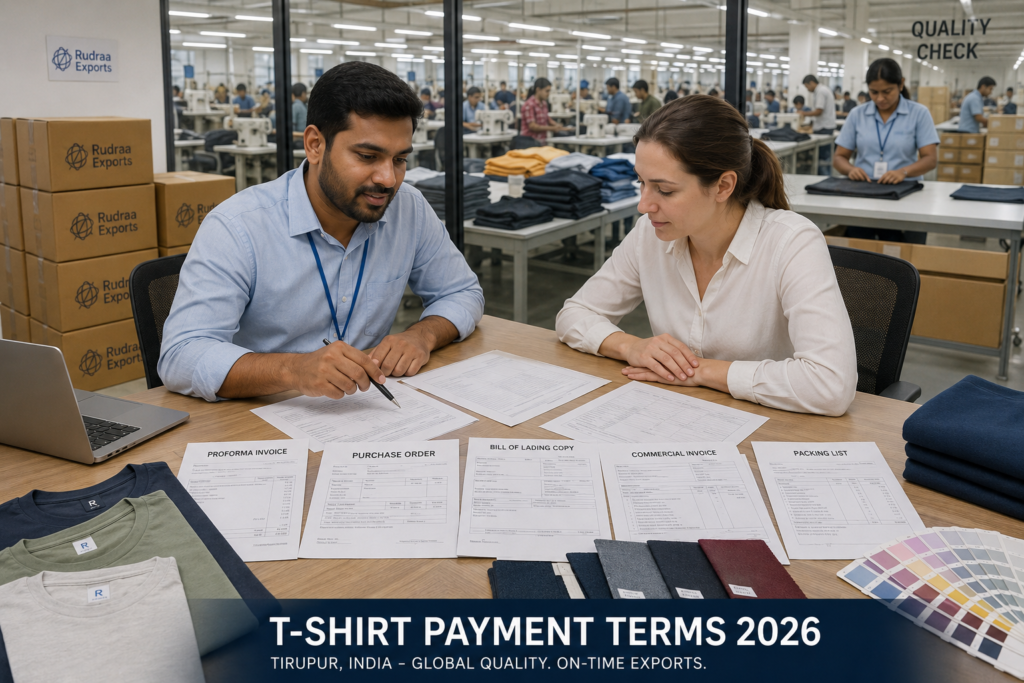
Understanding T-shirt manufacturer payment terms in 2026 is not optional for international buyers. If you misunderstand deposits, balance payments, letters of credit, open account terms, documentary collections, or payment against Bill of Lading, you can create cash-flow problems, shipment delays, supplier distrust, or legal disputes before your first bulk order even leaves the factory.
Most apparel suppliers, especially for new buyers and custom T-shirt programs, will not produce bulk goods without some financial commitment. The uploaded research shows that across apparel manufacturing, common starting structures include 30–50% deposits, with 30/70 and 50/50 splits appearing frequently in sourcing guidance. The balance is often paid before shipment or against shipping documents such as a copy of the Bill of Lading.
At Rudraa Exports, we support international buyers looking for factory-direct Tirupur T-shirt and knitwear manufacturing with clear commercial terms, export documentation, and practical payment structures. This guide explains what buyers should realistically expect when sourcing T-shirts in 2026.
Quick Answer
International buyers sourcing custom T-shirts in 2026 should usually expect a 30–50% deposit before production, with the balance paid before shipment or against a copy of the Bill of Lading. New buyers commonly face 30/70 or 50/50 terms, while established buyers with strong credit may negotiate open-account terms such as Net 60, Net 90, or longer retailer-driven cycles. Safer payment tools include irrevocable Letters of Credit, documentary collections, export credit insurance, factoring, and platform escrow services.
Need payment terms for your specific T-shirt order? Contact Rudraa Exports to share your quantity, destination market, Incoterm, and preferred payment structure.
Why Payment Terms Matter in T-Shirt Manufacturing
Payment terms are not just finance details. They control risk.
For the manufacturer, payment terms protect cash flow because the factory must buy yarn, fabric, trims, labels, packaging, and labor before receiving full payment. For the buyer, payment terms protect against poor quality, late delivery, incorrect documents, or supplier non-performance.
A bad payment structure can hurt either side.
If the buyer pays too much upfront, they carry supplier risk. If the supplier offers too much credit to an unknown buyer, they carry non-payment risk. A good payment term balances both sides.
Common T-Shirt Manufacturer Payment Terms in 2026
Most new buyer relationships start with partial advance payment. This is normal in custom apparel manufacturing.
| Payment Structure | How It Works | Best Used For |
|---|---|---|
| 30% deposit / 70% before shipment | Buyer pays 30% to start production, 70% before goods ship | New buyers, standard custom orders |
| 30% deposit / 70% against B/L copy | Balance paid when shipping document is available | Export orders where shipment proof is needed |
| 50% advance / 50% balance | Higher upfront commitment | Small custom orders, high material risk |
| L/C at sight | Bank guarantees payment once documents comply | Larger orders, new international relationships |
| Open account Net 60–120 | Buyer pays after shipment/delivery cycle | Established buyers with strong credit |
| Documentary collection DP/DA | Bank handles documents and payment process | Trade relationships needing document control |
| Escrow / platform protection | Third-party platform holds or controls payment | Online sourcing, first-time SME transactions |
The uploaded research identifies these as common apparel trade structures, including T/T, L/C, open account, documentary collections, cash in advance, and platform-based payment protection such as Alibaba Trade Assurance.
Deposit Requirements: What Buyers Should Expect
For first orders and custom T-shirt production, buyers should expect a deposit. Complaining about deposits is pointless. The better move is to negotiate the amount, trigger, and protection mechanism.
The research shows that 30–50% upfront deposit is commonly referenced in apparel sourcing. Custom apparel can often involve higher deposit requirements because the supplier must reserve materials and production capacity.
Deposit Comparison Table
| Deposit Type | Buyer Risk | Supplier Risk | Practical Use |
|---|---|---|---|
| 20% deposit | Lower buyer risk | Higher supplier risk | Strong buyer leverage or repeat relationship |
| 30% deposit | Balanced starting point | Manageable | Common for standard apparel sourcing |
| 50% deposit | Higher buyer risk | Lower supplier risk | Custom orders, small runs, costly materials |
| 100% advance | Highest buyer risk | Lowest supplier risk | Usually only for very small or platform orders |
For most international buyers, a reasonable target is 30% advance with the balance tied to inspection and documents. If the factory asks for 50%, the buyer should ask why. Valid reasons may include custom-dyed fabric, special trims, low MOQ, private-label packaging, or expensive raw materials.
When Is the Balance Usually Paid?
The remaining balance is commonly paid before shipment or against shipping documents.
Balance Before Shipment
This is common for first-time buyers. The factory completes production, the buyer or inspector checks the goods, and the buyer pays the balance before the factory releases the shipment.
This protects the supplier from shipping goods without payment.
Balance Against Copy of Bill of Lading
In export trade, the Bill of Lading proves that goods have been shipped. Some agreements trigger the balance payment against a copy of the B/L.
The uploaded research notes that some sources blur whether “against B/L” means strictly before vessel departure or shortly after shipment once documents are issued, but the consistent point is that payment is triggered by shipping documentation rather than final delivery.
Open Account After Shipment
Open-account terms are buyer-friendly because the buyer pays after shipment or after a defined period. But suppliers usually reserve this for established buyers, large retailers, insured receivables, or credit-backed relationships.
The uploaded research mentions apparel payment cycles of 60–120 days in retailer-driven supply chains.
Payment Method Comparison for International T-Shirt Buyers
| Payment Method | Buyer Protection | Supplier Protection | Best For |
|---|---|---|---|
| T/T bank transfer | Medium | Medium | Most SME and custom orders |
| L/C at sight | High | High | Larger export orders |
| Documentary collection | Medium | Medium | Document-controlled trade |
| Open account | High for buyer | Low unless insured | Large repeat buyers |
| Cash in advance | Low for buyer | High for supplier | Small orders, high-risk buyers |
| Escrow / Trade Assurance | Medium to high | Medium | Online sourcing and first orders |
There is no perfect payment method. The best structure depends on order size, relationship maturity, destination country, supplier risk, buyer credit strength, and whether banks or insurers are involved.
T/T Payment Terms: Simple but Requires Discipline
T/T, or telegraphic transfer, is one of the simplest payment methods in apparel sourcing. The buyer sends money directly by bank transfer.
A common structure is:
30% T/T advance + 70% T/T balance after inspection and before shipment.
This works if both sides are professional. But buyers must protect themselves by tying the balance to clear conditions:
✅ Production completed
✅ Final inspection passed
✅ Packing list confirmed
✅ Commercial invoice checked
✅ Shipment schedule confirmed
✅ Photos and carton details reviewed
✅ Draft shipping documents verified
Do not pay the final balance blindly just because the factory says “goods are ready.”
Letter of Credit: Safer for Larger Orders
A Letter of Credit, or L/C, uses banks to reduce payment risk. The buyer’s bank promises payment to the supplier if the supplier presents compliant documents.
This is useful when:
- Order value is high
- Buyer and supplier are new to each other
- Supplier wants payment assurance
- Buyer wants document-based control
- Shipment involves formal export documentation
The uploaded research identifies irrevocable L/C, including L/C at sight, as a commonly evidenced risk mitigation tool in apparel and international trade.
L/C Pros and Cons
| Pros | Cons |
|---|---|
| Reduces non-payment risk | Bank charges apply |
| Builds supplier confidence | Documentation must be exact |
| Useful for larger orders | More complex than T/T |
| Can unlock better commercial terms | Delays if documents have discrepancies |
For small orders, L/C may be overkill. For large orders, it can be worth it.
Open Account Terms: Good for Buyers, Risky for Suppliers
Open account means the supplier ships goods and the buyer pays later, such as Net 60, Net 90, or Net 120.
Buyers love open account because it improves cash flow. Suppliers dislike it unless the buyer is trusted, insured, or financially strong.
The uploaded research shows that open-account cycles in apparel supply chains can run 60–120 days, especially in retailer-driven models. It also notes that suppliers often manage this risk through trade credit insurance, factoring, or bank programs.
Who Can Usually Get Open Account?
✅ Long-term buyers with repeat orders
✅ Large retailers
✅ Buyers with strong credit history
✅ Buyers supported by trade credit insurance
✅ Buyers offering stable seasonal volume
✅ Buyers using bank-backed or insured structures
If you are a new brand placing your first 1,000-piece order, demanding Net 90 from a factory is unrealistic. You have no leverage.
Regional Differences in T-Shirt Payment Terms
Payment expectations vary by sourcing hub.
| Region | Typical Pattern |
|---|---|
| India | Advance + balance against B/L or L/C; export credit insurance may support credit |
| China | 30/70 structures common; platform protection often used in online sourcing |
| Bangladesh | Greater reliance on L/C and back-to-back L/C structures |
| Vietnam | T/T common; open account possible for trusted buyers |
| Turkey | Factoring and insured receivables common in export corridors |
The uploaded research notes that India-focused exporter discussions reference 50% advance with the remainder against B/L or via L/C, while China sourcing strongly associates with 30/70 terms, Bangladesh often uses L/C structures, Vietnam may offer Net 60 for established relationships, and Turkey shows stronger use of factoring and insured receivables.
How Buyers Can Negotiate Better Payment Terms
You cannot demand better terms without giving the supplier a reason.
To negotiate better terms, offer:
✅ Repeat-order forecast
✅ Larger confirmed volume
✅ Faster approval timelines
✅ Reliable documentation process
✅ Strong buyer references
✅ L/C at sight instead of risky open account
✅ Credit insurance support
✅ Shorter payment cycle after shipment
✅ Deposit tied to material booking only
✅ Balance tied to inspection and document release
A good negotiation is not “reduce advance.” A good negotiation is “reduce risk for both sides.”
Recommended Payment Structures by Buyer Type
| Buyer Type | Recommended Structure |
|---|---|
| First-time small brand | 40–50% advance, balance after inspection before shipment |
| Serious SME buyer | 30% advance, 70% after inspection / against B/L |
| Repeat buyer | 20–30% advance, balance against documents |
| Large retailer | L/C, insured open account, or Net 60–120 |
| High-risk custom program | Higher deposit or milestone-based payment |
| Platform sourcing buyer | Escrow / Trade Assurance where available |
For most factory-direct custom T-shirt buyers, 30/70 with inspection before balance is a practical target.
Risk-Control Clauses Buyers Should Add
Payment terms should not stand alone. They should connect to quality, documents, and remedies.
Add clauses such as:
✅ Deposit becomes active after final tech pack approval
✅ Bulk production starts only after PP sample approval
✅ Balance payable only after final inspection pass
✅ Supplier must provide draft invoice and packing list before balance
✅ Buyer can hold balance if shipment fails AQL
✅ Re-inspection cost paid by supplier if failure is supplier-caused
✅ Late shipment remedies defined in PO
✅ Incorrect documents must be corrected before final payment
✅ No shipment release without buyer approval
This is not being difficult. This is professional sourcing.
Why Rudraa Exports
Rudraa Exports is positioned for international buyers who want factory-direct T-shirt sourcing from Tirupur with clear commercial communication and export documentation support.
Manufacturing Capabilities
- Factory-direct Tirupur T-shirt and knitwear manufacturing
- 72,000+ units per month production capacity
- Custom men’s round-neck T-shirts, polos, uniforms, sportswear, kidswear, and private-label knitwear
- MOQs starting from around 300 pieces per style, depending on fabric, color, and customization
- Fabric sourcing, sampling, cutting, stitching, finishing, packing, and export documentation support
Quality and Compliance
- ISO 9001:2015 certified manufacturing approach
- AQL 2.5 inspection standards
- Support for buyer-defined inspection and payment-linked QC checkpoints
- Documentation support for commercial invoice, packing list, B/L coordination, certificate of origin, and buyer-required export files
- Certification-aligned sourcing support for OEKO-TEX, GOTS, GRS, BSCI, SMETA, WRAP, and related buyer standards where applicable
International Buyer Advantages
- Factory-direct pricing without trading-company markups
- Up to 40% cost-saving positioning compared with indirect sourcing models
- Clear payment discussions based on order size and buyer relationship stage
- English-language communication for global buyers
- Export support for EU, USA, Australia, and Middle East markets
- Multi-port shipping through Tuticorin VOC, Chennai, and Cochin
Ready to discuss payment terms for a factory-direct T-shirt order? Speak with Rudraa Exports for a transparent quote structure based on quantity, Incoterm, inspection plan, and shipment destination.
FAQ: T-Shirt Manufacturer Payment Terms
1. What payment terms should I expect from a T-shirt manufacturer?
For a new buyer, expect a 30–50% deposit before production and the balance before shipment or against shipping documents. The exact split depends on order size, customization, relationship history, and supplier risk.
2. Is 30% deposit and 70% balance normal in apparel sourcing?
Yes. The uploaded research shows that 30/70 is repeatedly cited as a common apparel and textile sourcing structure, especially for supplier relationships where the buyer pays a deposit before production and the balance before shipment or against B/L.
3. Is 50% advance too high?
Not always. A 50% advance can be normal for custom apparel, small runs, high material risk, special trims, or first-time buyer relationships. But buyers should connect the advance to clear production milestones and documentation.
4. When should I pay the final balance?
The safest structure is to pay the final balance after production is complete, after final inspection has passed, and after draft shipping documents are reviewed. Some suppliers request payment against a copy of the Bill of Lading.
5. What is payment against Bill of Lading?
Payment against Bill of Lading means the balance is triggered by shipment documentation. The B/L acts as proof that the goods have been shipped or are under carrier control, depending on the specific document and arrangement.
6. Can I get open account terms from a T-shirt factory?
Yes, but usually only after trust is built. Open account terms such as Net 60 or Net 90 are more common for established buyers, large retailers, or relationships supported by credit insurance, factoring, or bank programs.
7. What is the safest payment method for international T-shirt sourcing?
For larger orders, an irrevocable Letter of Credit at sight can be safer because banks control payment against documents. For smaller orders, T/T with deposit, inspection-linked balance, and clear PO terms is common.
8. Should I use Alibaba Trade Assurance or escrow?
Escrow-like platforms can help first-time buyers reduce risk when sourcing through online marketplaces. For direct factory relationships, buyers usually rely on bank transfer, L/C, inspection controls, and contract terms.
9. Can payment terms be negotiated?
Yes, but only if the buyer reduces supplier risk. Repeat orders, larger volume, strong credit, L/C support, faster approvals, and clean documentation can help negotiate better terms.
10. What payment terms are common in India for T-shirt manufacturing?
India-focused exporter discussions in the uploaded research reference advance payment with the balance against B/L or via L/C. Conservative advance-plus-document structures are common for new international relationships.
11. Should final payment be linked to inspection?
Yes. Buyers should link final payment to final inspection pass, document review, and packing confirmation. Paying the full balance before inspection removes buyer leverage.
12. What should I include in the PO about payment?
Include deposit amount, balance trigger, currency, bank charges, inspection requirements, document requirements, shipment release conditions, late delivery remedies, and what happens if goods fail AQL.
Conclusion
T-shirt manufacturer payment terms in 2026 depend on buyer trust, order size, customization level, sourcing country, risk controls, and financial tools. For new buyers, the most realistic expectation is a 30–50% deposit with the balance due before shipment or against shipping documents. Open-account terms such as Net 60–120 are possible, but usually only for established buyers with strong leverage or risk mitigation support.
Related guides: how Rudraa Exports compares to other suppliers, the direct factory vs agent sourcing cost breakdown, and what to expect when starting a supply partnership.
Visit rudraaexports.com or contact our team directly to share your T-shirt requirement, quantity, Incoterm, payment preference, and destination market — and receive a transparent factory-direct quote built for serious international buyers in 2026.